[“The following copyrighted article is shared
with permission, and courtesy of theartpulse.com”]
Source link
An Article by DM. (949 words, 5 min. read)
Reading The Raft of the Medusa in the Light of Lebanon

A Painting That Doesn’t Remain in the Past
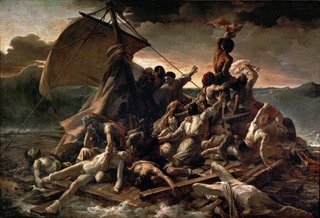
When Théodore Géricault unveiled The Raft of the Medusa in 1819, he was not merely depicting a maritime tragedy. He was revealing a brutal truth about humanity in times of catastrophe.
The story behind the painting is known. In 1816 the French frigate Méduse ran ground off the coast of Mauritania after catastrophic leadership and political negligence. Too many passengers, too few lifeboats. A makeshift raft was constructed and more than one hundred people were abandoned upon it.
For thirteen days they drifted in the Atlantic.
Starvation, dehydration, madness, and violence followed.
When the rescue ship finally arrived, only fifteen survivors remained.
Yet the power of Géricault’s painting does not lie in its historical accuracy alone. It lies in something far more disturbing: the realization that this raft is not just a raft. It is a portrait of humanity when the structures meant to protect it collapse.
Two centuries later, the image feels painfully familiar. The raft may have changed form, but the human figures upon it have not.
The Silence of the Dead

Let us begin at the bottom of the painting.
In the foreground lie the bodies of those who have already lost the struggle. Limbs hang heavy across the wooden planks. Skin appears pale, almost sculptural in its stillness.
One figure sits in tragic immobility holding the body of a younger man across his knees. The gesture resembles a modern one Pietà. The father does not cry, does not move. His grief has passed beyond expression.
This is the zone where hope no longer exists.
The sea continues to move. The raft continues to drift. But for these figures, time has stopped.
Looking at this part of the canvas today is unsettling. The composition could easily resemble contemporary images emerging from modern war zones. The stillness of bodies in ruined streets, the unbearable quiet after explosions, the sudden transformation of life into absence.
Lebanon knows this silence well.
From the long years of the Lebanese Civil War to the more recent conflicts that have scarred the country’s landscape, the same images have appeared again and again. The geography may change, yet the human posture of loss remains identical.
Géricault painted death in 1819.
We still recognize it immediately.
The Weight of Survival

Moving upward through the painting, the dead give way to the living.
But life here is fragile.
Several survivors lean against one another in exhaustion. Their bodies bend forward as if gravity itself has become heavier. Hunger and thirst have hollowed their gestures.
These men are still alive, yet they are no longer struggling. They simply wait.
Waiting becomes its own form of suffering.
Géricault understood something fundamental about catastrophe: survival is not always heroic. Sometimes it is only endurance, the slow passage of time while the body weakens and the mind begins to doubt rescue.
The same suspended time has marked Lebanon’s history. During the years of the civil war, entire neighborhoods lived in this state of waiting. Waiting for shelling to stop. Waiting for electricity to return. Waiting for a future that seemed permanently postponed.
In these moments, a city itself becomes a raft.
People continue their daily lives in fragments. Cafes open. Children go to school. Conversations resume. Yet beneath these gestures lies the same tension visible in Géricault’s figures: the fragile knowledge that everything could collapse again.
The raft drifts.
The waiting continues.
The Desperate Gesture Toward the Horizon


At the top of the composition the painting suddenly changes rhythm.
The bodies rise upward in a powerful diagonal movement, forming a pyramidal structure of urgency. Several survivors climb over the others, toward the distant horizon.
One man waves a cloth with frantic determination.
In the far distance, barely visible, a ship appears.
It is the Argus, the vessel that will eventually rescue them.
Yet the distance is terrifying. The ship is small, almost dissolving into the sky. The viewer cannot know whether the signal will be seen.
This fragile moment of hope resonates deeply today. In every conflict zone the same gesture repeats itself. Civilians wave from balconies during bombardments. Refugees signal rescue boats across dangerous seas. Families trapped beneath rubble wait for the sound of rescuers above them.
Lebanon has witnessed these gestures countless times.
From the wars that fractured the country for years to the many conflicts that have since touched its borders, people continue to look toward the horizon with the same question that fills Géricault’s painting:
Will anyone save us?
The Raft as a Mirror of War
What makes The Raft of the Medusa Timeless is not its historical narrative but its structure.
The painting organizes humanity into three fragile states:
the dead, the exhausted, and the hopeful.
Every war creates this same tragic hierarchy.
Some disappear immediately.
Some endure the long erosion of waiting.
Some continue to search for a distant possibility of rescue.
Lebanon’s history has moved repeatedly through these same stages. The civil war fractured communities and cities. Entire generations learned to live with uncertainty. Even today, regional conflicts and internal tensions remind the country how fragile stability can be.
The raft is no longer drifting in the Atlantic Ocean.
It may be drifting through cities, borders, and histories.
But the human figures remain unchanged.
Two centuries after Géricault painted this immense canvas, the world has invented new weapons, new technologies, and new political languages.
Yet when catastrophe arrives, humanity still arranges itself exactly as it did on that fragile wooden raft.
Some fall.
Some wait.
Some wave desperately towards the horizon.
And the sea continues to move.