
[“The following copyrighted article is shared
with permission, and courtesy of theartpulse.com”]
Source link
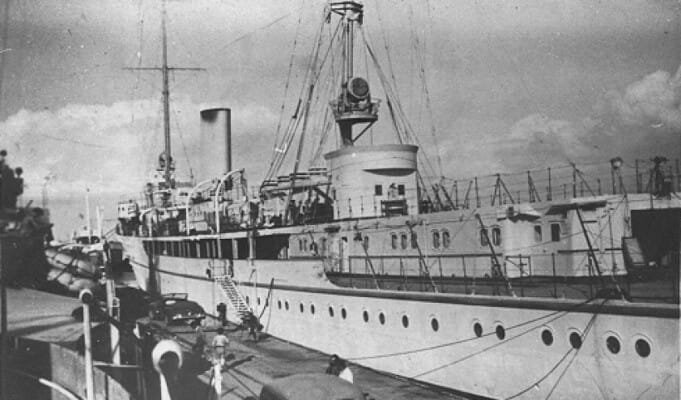
Browseoccupation armyA narrative of a secret operation carried out inBeirut Port In late 1948, he said it targeted a ship that was anchored in the port, allegedly to prevent it from being converted into a naval vessel for the Egyptian army during the war. This came in a material published by the army on the occasion of what is known as “Remembrance Day” for the dead of Israel, in which it presented details of what it called “Operation David,” noting that the operation was carried out in cooperation between the Navy and the “Mustaza’ribin” unit after the merger of the Zionist gangs.
The publication of this material comes within the framework of the occupation army’s restoration of previous operations and presenting them as military and security achievements, within official narratives presented annually at commemorative events, and which are based on a unilateral account of the facts without support from independent sources.
According to the Israeli story, the operation came against the backdrop of intelligence information about the arrival of a ship called “igress” To the port of Beirut in September 1948, a ship that the army said had previously been used byAdolf HitlerAnd senior Nazi officials, before its ownership was later transferred and sold to a businessmanLebanonAfter the British Navy had taken control of it in…World War IIWhile it is claimed that the king of EgyptFarouk IHe was behind its purchase with the aim of converting it into a warship.
Estimates of the nascent occupation army at the time suggested the possibility of equipping the ship with cannons and putting it into service within the Egyptian Navy, which it considered a threat that required “thwarting” through a sabotage operation inside the Lebanese port.
In this context, the Israeli army quoted one of the researchers in the history of the intelligence unit, saying that the “Musta’arabim” members worked inside Beirut to collect information about the ship, by integrating into the local environment, taking pictures and drawing maps of the port “with civilian cover,” in addition to communicating with local sources to obtain detailed information.
According to the Israeli story, it was decided to carry out a sabotage operation through a member of the unit who was qualified to carry out a diving mission and plant explosive devices. He was sent to the port swimming at night carrying four mines, and he was able to install them on the ship’s hull before returning to the starting point.
According to Israeli allegations, the devices did not explode immediately, due to a delay mechanism based on chemical components, and that the explosion occurred later, causing damage that it said led to the ship being disabled and taken out of service.
The official version reported by the Israeli army also stated that attempts to repair the ship “failed,” and that it was later transferred to the United States with the aim of selling it, before it was eventually dismantled, which the Israeli army considered “removing a potential threat” at that stage.
In a broader context, the Israeli army reviewed the development of the “Musta’arabim” unit since its establishment during the British Mandate period. He pointed out that the nucleus of the “Musta’rab” units was formed by a decision from the leadership of the “Palmach” gang, which established what was known as the “Arab Section” under the name “Hashahar,” with the aim of collecting information from within Arab societies.
After the “Palmach” was integrated into the Israeli army in 1948, this unit was attached to the Israeli military system under the name “Intelligence 18(Modi’in 18)”, to work within the intelligence service.
According to what was reported by the Israeli army, members of this unit were active inside historic Palestine as well as in Arab countries, including Lebanon, Syria, and Iraq, where they integrated into local communities and carried out espionage and information-gathering missions.
These “Arabists” also carried out operations to smuggle Jews into the 48 regions during the mandate period, establishing agent networks and carrying out secret missions, within the framework of what the Israeli narrative describes as efforts to “build the intelligence capacity” of the emerging state.