[“The following copyrighted article is shared
with permission, and courtesy of theartpulse.com”]
Source link
An Article by MR (851 words, 4 min. read)
The large white space of Saleh Barakat Gallery does something unusual here. It becomes the perfect setting for these assemblages, allowing every detail, object, interruption, and visual encounter to breathe while immersing the viewer inside a world overflowing with thoughts, memories, references, and unexpected connections.
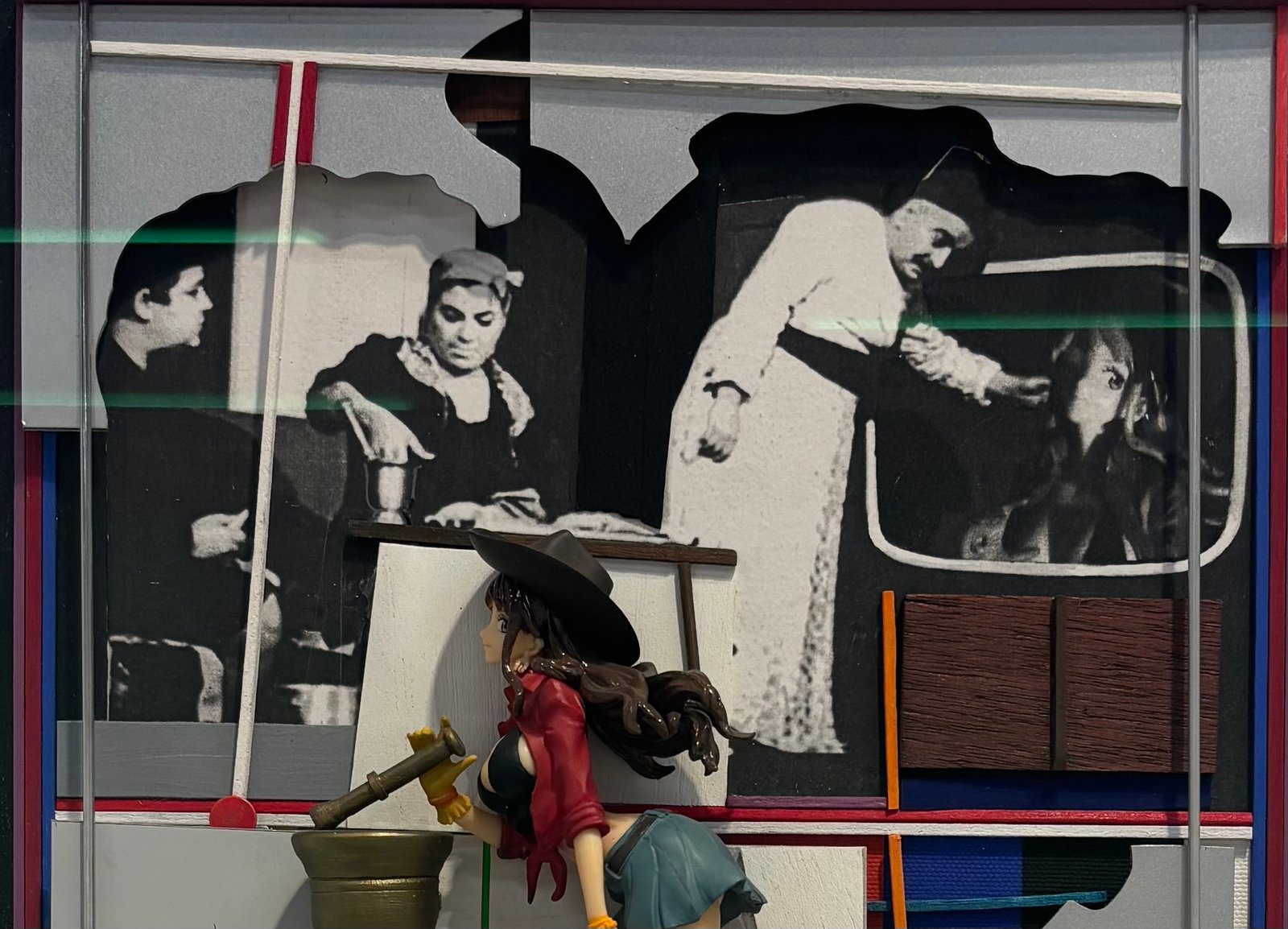
From afar, the assemblies almost appear disciplined through their geometric structures and carefully measured compartments. Yet the closer one approaches, the more the order begins to slip away. A doll suddenly stars from the middle of a painted surface.
A fragment of art history collides with a decorative motif. Tiny objects hide beside photographs like secret jokes left for attentive viewers.
Nothing stays where one expects it to remain.
The works seem to behave like conversations interrupted halfway through, only to continue again somewhere else entirely. And strangely, after the initial confusion, the eye begins to relax instead of resisting.
Perhaps there is relief in finally accepting that not everything arrives in life with perfect clarity. Must everything really make sense?

The Collector of Impossible Conversations
There is something almost obsessive in the way these works are constructed.
Every object appears chosen with the patience of someone building a private universe piece by piece over decades. Mohammad El Rawas collects figurines, fragments, toys, photographs, manga characters, decorative elements, and visual memories the way others collect stories. Mickey Mouse suddenly appears beside a photograph of Tagreed Darghouth’s painting, while Abou Melhem and Em Melhem coexist with a PVC figurine of Nami from the anime and manga series One Piece. Elsewhere, references to Delacroix, Artemisia Gentileschi, and Gauguin emerge naturally fragment amongs of photographs and painted details, each element occupying the same visual importance inside the composition.

Nothing dominates permanently because everything participates equally in the construction of meaning.
Even the bonsai wood used in certain assemblages carries the trace of careful transformation, cut, shaped, preserved, and integrated into compositions with extraordinary precision. There is discipline everywhere in these works, but it is the discipline of someone organizing chaos lovingly rather than eliminating it.
Every detail feels meticulously placed, every compartment measured, every visual interruption calculated with remarkable care. The compositions remain dense yet surprisingly clean, almost surgical in their precision despite the accumulation of references.
Perhaps perfection itself sometimes comes from learning how to organize disorder instead of controlling it completely?

Looking Like a Child Again
There is something deeply childlike in the way these works operate. Not childish, but childlike in the freedom with which unrelated things naturally coexist together. Children place impossible worlds side by side without needing explanation. A cartoon figure can speak to a Renaissance painting without anyone questioning the logic of the encounter.
These assemblages recover that forgotten visual freedom. A small ceramic figure suddenly becomes more emotionally powerful than a monumental painted fragment. Decorative patterns begin participating in emotional conversations.

Serious references lose their authority and enter visual games instead. Looking at these works sometimes feels less like analyzing art and more like opening drawers filled with objects collected throughout an entire lifetime for reasons impossible to explain rationally. The assemblages understand instinctively that memory never organizes itself academically. Personal culture forms itself through accidents, television, museums, childhood, cinema, war, books, cartoons, advertisements, and private obsessions all mixed together inside the same emotional space.
Perhaps imagination itself never truly made sense in the first place?

Beirut as a State of Mind
Without directly depicting the city, the works somehow recreate the sensation of living inside Beirut itself.
Layers accumulate endlessly. Different times continue existing beside one another. Beauty survives beside exhaustion. Humor appears at the exact moment seriousness becomes unbearable. Old memories refuse to disappear completely under newer realities.

Walking through these assemblages resembles walking through streets where histories overlap continuously without asking permission from one another. Nothing feels isolated. Every object seems touched by another invisible story nearby. Even the visual overcrowding feels familiar, as though the works understand emotionally what it means to inhabit spaces filled with emotional residue, interrupted histories, and fragile forms of survival.
Beirut appears here less as geography than as rhythm, a rhythm made from tension, irony, nostalgia, and persistence all existing simultaneously.
Could any city shaped by memory and survival ever become fully logical?
The Strange Pleasure of Getting Lost
Most people are taught to fear confusion. Yet these assemblages suggest something else entirely, that confusion may sometimes open emotional doors that certainty immediately closes. The eye wanders without destination. Meaning shifts constantly. A detail ignored at first suddenly becomes central twenty minutes later. The works continue to change internally depending on the viewer’s emotional state, attention, memories, and personal obsessions. Nothing remains fixed long enough to become dead.

Even after leaving the gallery, fragments continue returning unexpectedly like unfinished dreams. A figurine reappears mentally during dinner. A strange combination of images suddenly makes emotional sense hours later for reasons impossible to articulate.
Perhaps that lingering uncertainty is precisely what keeps the works alive inside the mind. And perhaps the real danger today is not confusion itself, but the illusion that everything should always make sense.