
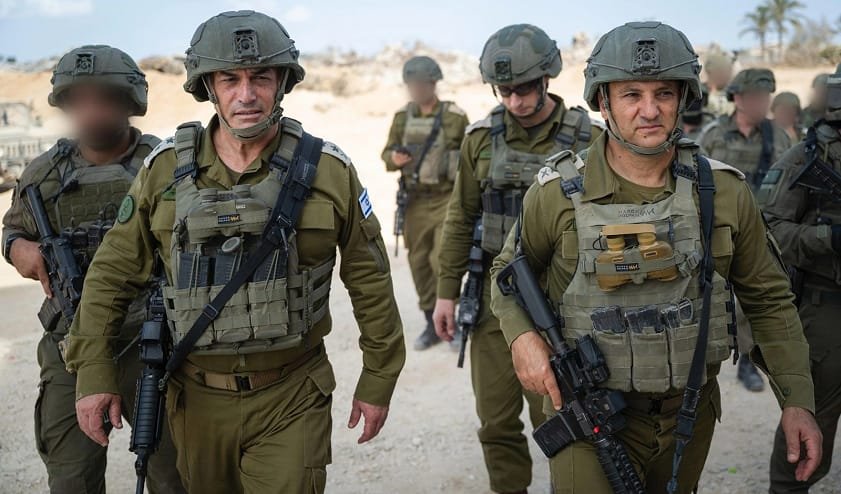
“The occupied region in Lebanon is a tactical achievement in the short term, but it is a military burden in the long term. The occupation of Beaufort entered the Israeli consciousness as a tragedy and settled in it as a farce. It would restore the claim that has declined in recent years that Hezbollah is protecting Lebanon.”
Israeli analysts: There is no strategic importance to the occupation of Beaufort Castle
Today, Monday, Israeli analysts downplayed the military importance of the Israeli army’s occupation of Beaufort Castle in southern Lebanon, at the end of last week, and stressed that its occupation had no impact on Hezbollah’s resistance to the Israeli ground incursion and that this would not stop the launching of missiles and marches towards Israeli targets.
The former commander of the Israeli Military Intelligence Division and head of the National Security Research Institute at Tel Aviv University, Tamir Hayman, indicated on the Channel 12 website that “this escalation stems from the deepening of the Israeli army’s invasion and Hezbollah’s broad response to it,” and that after occupying the citadel, “the Israeli army is preparing to expand its operations towards the city of Tire and Wadi Marj Uyoun.”
He added that from a tactical standpoint, although Al-Shaqif “constitutes a controlling area overlooking (northern Israel), and the importance that Hezbollah attaches to it gives it a symbolic-strategic value, the question is: What is the strategic goal of expanding the operation? Although this is an area from which drones and fire were launched towards our forces, it must be noted that the firing is taking place from many other areas, and this occupation will not lead to eliminating the danger.”
Hayman pointed out that the occupation of Beaufort Castle would hinder the talks between Israel and Lebanon in Washington because it constitutes “an insult to the Lebanese government in front of its citizens as a result of Israeli military pressure.”
He considered that this occupation would lead to pressure on Iran to soften its positions in the negotiations with the United States, because Iran is demanding that a ceasefire be included in Lebanon, “and the fact is that Hezbollah is losing resources and its position in Lebanon is eroding with the passage of time, but the problem is that Israel is thus linking the two fronts, which contradicts its principled position that the Lebanese file is separate from the Iranian file.”
Hayman claimed that another goal of the occupation of Beaufort Castle is that it constitutes “a solution, in the view of the government and the Israeli army, to the internal criticism regarding the lack of response to Hezbollah’s operations and the continued shooting in northern Israel, and the anger and frustration that pushes the heads of local authorities and residents in the north into real distress. This distress requires action. In the wake of the fact that Israel is restricted in firing (at an American request), responding through an incursion (in Beaufort) is the only available way out.”
He continued, “The truth seems to be that all of these goals are linked, but all of them do not provide a long-term solution to Hezbollah’s problem. Even the occupation of the Nabatieh Heights, the city of Tyre, and all the lands up to the Litani will not lead to the defeat of Hezbollah. Its center of gravity is in Baalbek and Beirut. Its long-range missile capabilities are spread deep into all Lebanese territory. With regard to explosive marches, anywhere there is a population there is the ability to produce and launch deadly marches.”
Hayman pointed out, “The problem begins after we occupied the region. Controlling it requires a large number of forces, and withdrawing from it is not realistic before the elections in Israel. It is difficult to see the Israeli government withdrawing from Lebanon in exchange for an agreement of understandings with the weak Lebanese government. That is, the occupied region is a tactical achievement in the short term, but a military burden in the long term, unless an agreement is reached in which Hezbollah is disarmed by an American force that helps the Lebanese army and with international leadership, so that the army withdraws.” “It is difficult to see an agreement like this being achieved soon. The American president is completely immersed in the war in Iran, the midterm elections, and thinking and planning for regime change in Cuba, and Lebanon is far from his priorities.”
According to Hayman, “The truth must be told to the Israeli public, which is that the disarmament of Hezbollah will only take place through political action with a military effort. This will take a very long time, and will not completely eliminate the danger of Hezbollah. As long as the Iranian regime exists, and sees the presence of Hezbollah as a vital Iranian interest, Iran will create a threat to Israel in the north.”
The political analyst in the Yedioth Ahronoth newspaper, Nahum Barnea, stressed that “the situation in the north is unbearable, because a million Israeli citizens live under a tangible threat to their lives, livelihood and well-being, and because the state brought them into this situation by initiating a military operation in order to guarantee their security in advance. It is unbearable because what the Israeli army is doing in southern Lebanon these days does not reduce by one centimeter the level of danger and the level of illness in the north, and it is unbearable because instead of facing the price of a military operation, we are obstructed.” We tell ourselves stories.”
He added that, as is happening now, “In 1982, we crossed the Litani and occupied Shaqif. The occupation of Shaqif entered the Israeli consciousness as a tragedy, due to the killing of the Golani brigade commander, and settled in the consciousness as a farce, after the visit of the Prime Minister, Menachem Begin, and his question, ‘Did they have shooting machines?'” He expected that Israeli Prime Minister Benjamin Netanyahu and Defense Minister Yisrael Katz would visit Al-Shaqif and that their photos would be taken there.
He continued, “We are doing in Lebanon now what we did in 1982. What does not succeed by force will succeed with greater force. This is the combat doctrine. Sometimes it succeeds and sometimes it does not succeed; and sometimes we need 18 bleeding years, to no avail, to realize that this does not succeed,” referring to Israel’s unilateral withdrawal from southern Lebanon in the year 2000.
Barnea pointed out that the war on Lebanon enjoys consensus in Israel, and that Naftali Bennett and Gadi Eisenkot, the two candidates for prime minister from the opposition party bloc, support the war in their daily publications, and that Channel 12, the most watched in Israel, “demands to see Beirut on fire.”
He added, “It should not be ruled out that Bennett and Eisenkot are pushing to expand the war because they believe that this is what a certain electorate wants to hear.”
According to Barnea, “Beaufort Castle belongs to the world of marketing and not to the world of combat. The original plan for the attack in Lebanon did not include Beaufort nor the Litani. The army was drawn there because of the difficulty of confronting the issue of marches and popular pressure. It is difficult to see how controlling other areas in Lebanon will lead to a solution to the problem of marches and drones. It is possible to see how it will sink (in the Lebanese mud) for a long time and injure many Israeli soldiers.”
For his part, the military analyst in the newspaper “Haaretz”, Amos Harel, pointed out that “instead of raising the required question marks about the questionable strategy of the current war in the north, and about the absence of a tactical solution to the explosive marches that Hezbollah launches dozens of daily, we received nostalgia for the past about the impressive return to historical sites.”
He added that most Israelis “did not witness Lebanon closely in the 1990s, when mines planted by Hezbollah destroyed Israeli army convoys in the security belt. Ministers, Knesset members, and journalists spoke enthusiastically about Beaufort yesterday, as if the situation was different this time, and the occupation of the ancient Crusader castle would put an end to Hezbollah’s problem forever.”
He continued, “The artificial influence created for us by the media covers up the current bitter reality. This is a reality in which hidden ideological motives are mixed, and the nationalist Haredis are now dreaming of settlement and permanent control in southern Lebanon, with political distress for the government, which, with the elections approaching, is having difficulty explaining the abandonment of the residents of the north, with the embarrassment of the army, which after its victory over Hezbollah in the previous round in the year 2024, is now revealing its inability in the current war.”
Harel hinted that Netanyahu was lying when he said, last Friday, “We are operating in Beirut as well as in the Bekaa Valley, and we are directing strikes at Hezbollah,” but the reality is that Trump is “imposing significant restrictions on Israeli air strikes in Beirut.”
Israel sees Beaufort Castle as a “tactical image of victory”: “The fate of the war is decided in Washington”
He pointed out that the Israeli army “is in a state of operational and strategic failure, and Netanyahu is doing everything in his power to portray it to the Israeli public as a success. The current war round is completely different from the war in 2024, as Hezbollah no longer operates as an organized terrorist army and has returned to being a supporter organization and is not preoccupied with the plan to occupy the Galilee. Instead, it is looking for weak points that allow the killing of Israeli soldiers whenever they go deeper into Lebanon.”
Harel also pointed out that the occupation of Beaufort Castle “will not eliminate the danger of explosive marches from Israeli forces in Lebanese territory, and it appears that it will not thwart the launching of rocket shells, the targeting of which has expanded to Acre, Karmiel, and Safed.”
He added, “A new strategic problem may develop here. Hezbollah, despite its losses, succeeds in completely disrupting life in not-so-small areas near the Lebanese borders, and the Israeli army inflicts a number of deaths and dozens of injuries every week. While Netanyahu and Katz brag about occupying an area as a price paid by Lebanon, Hezbollah will once again restore the claim that has declined in recent years, as if it is the one protecting the state from Israeli aggression.”