
[“The following copyrighted article is shared
with permission, and courtesy of theartpulse.com”]
Source link
An Article by MR (605 words, 3 min. read)
The timing of this exhibition is impossible to ignore. As Lebanon once again finds itself surrounded by discussions of war, displacement, destruction and uncertainty, JAH Art Gallery presents a body of work that deliberately moves in another direction. In collaboration with gallery founder Ayman Badreddine, Mohamad Abdallah chooses not to contribute to the endless visual and verbal cycle of conflict. Instead, he turns toward the individual and the emotional realities that continue to exist despite everything.
This is not an escape from reality. It is a reminder that human beings do not stop loving, desiring, dreaming or remembering when war dominates the headlines.

The Human Figure at the Center
The exhibition revolves almost entirely around the human figure. This choice is all the more striking because the visual language itself is already familiar. Simplified bodies, rounded silhouettes, elongated limbs and carefully controlled contours have become a recognizable signature within Mohamad Abdallah’s work. Here, however, that established vocabulary is employed in the service of a different narrative. It explores intimacy, desire, vulnerability and the hidden emotional forces that shape human relationships. Faces are reduced to their essentials, details disappear and bodies become symbols. What remains is the essence of a gesture, a posture or a feeling.
A seated figure folded into itself, intertwined bodies or a hand resting quietly on a knee becomes enough to suggest intimacy, contemplation, loneliness or attraction. The paintings speak through suggestion rather than description.

Desire and Restraint
Despite its title, the exhibition is less concerned with eroticism than with the psychological territory surrounding desire. The works explore anticipation, vulnerability and emotional tension more than physical intimacy itself.
Many figures appear suspended between movement and stillness. Some seem to approach one another while others withdraw. Desire becomes a space of uncertainty where attraction coexists with hesitation and silence.

A Language of Reduction
One of the most striking aspects of the exhibition is its simplicity. Large monochromatic surfaces dominate the compositions. Deep reds, ochres, grays and dark backgrounds create a quiet but emotionally charged atmosphere.
The artist relies on remarkably few elements, yet manages to create images filled with psychological depth. Every curve, line and color carries meaning.

Many Versions of Ourselves
Among the strongest works is a large composition populated by dozens of fragmented white figures scattered across a dark background punctuated by colorful circles.
Each silhouette adopts a different position, as if illustrating the countless emotional states that define human experience. Some appear playful, others vulnerable, contemplative or restless. Together they form a choreography of human behavior and desire.

Beirut Appears
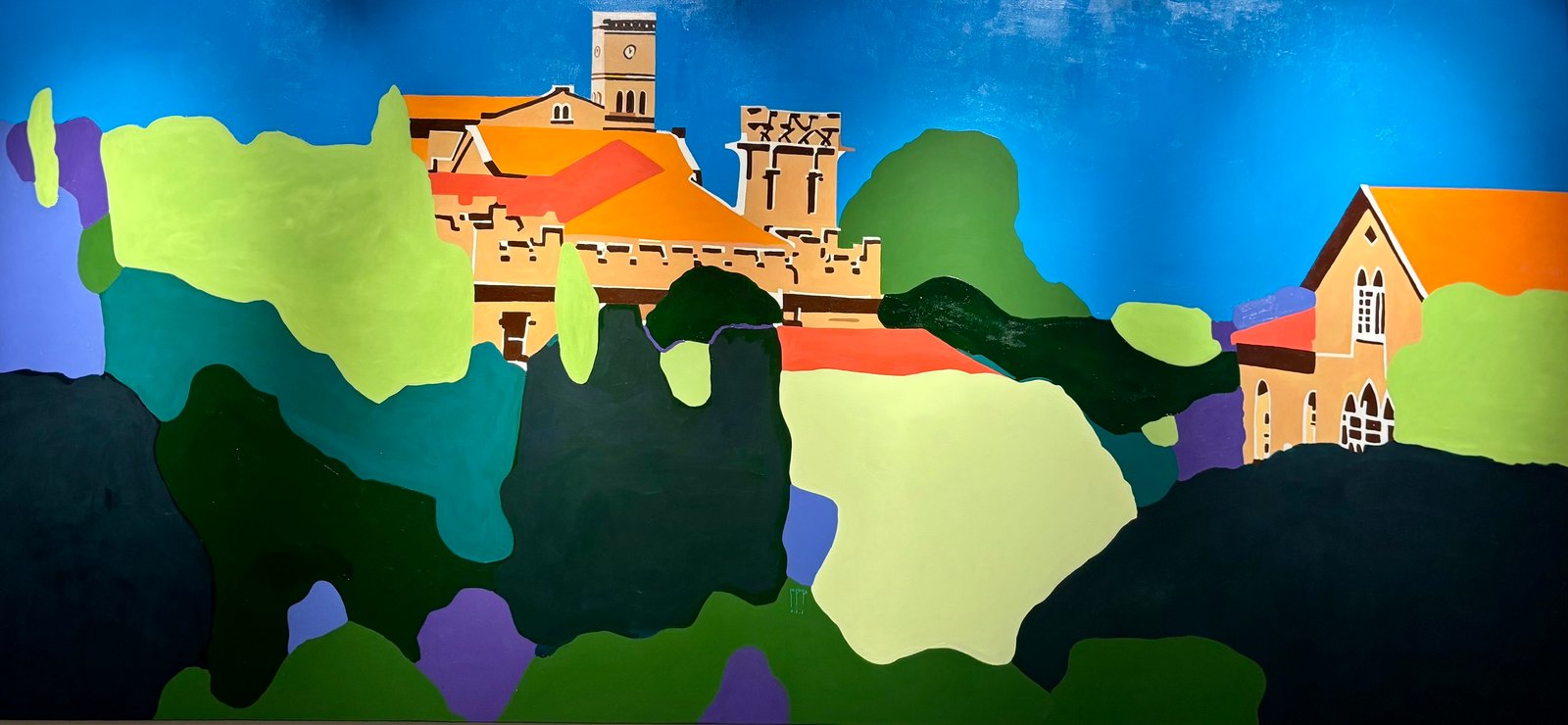
A monumental panorama of Beirut introduces an unexpected presence within the exhibition. Churches, rooftops and vegetation emerge through simplified forms and vibrant colors beneath an intense blue sky.
The city is not depicted through destruction or political symbolism. Instead, it appears calm, luminous and almost timeless. Just as the human body is reduced to its essential forms elsewhere in the exhibition, Beirut is distilled into memory, color and emotion.
Its presence creates an important bridge between the personal and the collective. The city becomes another protagonist within the exhibition.

What Remains Hidden
Throughout the exhibition, nothing is entirely revealed. The paintings resist clear narratives and definitive interpretations. They leave room for ambiguity, imagination and personal projection.
In choosing intimacy over conflict and introspection over spectacle, Mohamad Abdallah proposes a different way of looking at contemporary life. At a moment when public discourse is saturated with images of violence, these works insist on something quieter but equally essential: the persistence of human emotion.
That choice may be the exhibition’s most powerful statement.