[“The following copyrighted article is shared
with permission, and courtesy of theartpulse.com”]
Source link
An Article by DM (929 words, 5 min. read)
Art in Motion at the USEK Museum during La Nuit des Musées
There are paintings that continue to move long after the painter has laid down the brush. Their colors still breathe, their compositions continue their silent journey beneath the surface, and every layer of pigment preserves the memory of a hand that once searched for balance, rhythm and light. We simply no longer perceive that movement because time has accustomed us to seeing paintings as fixed images.
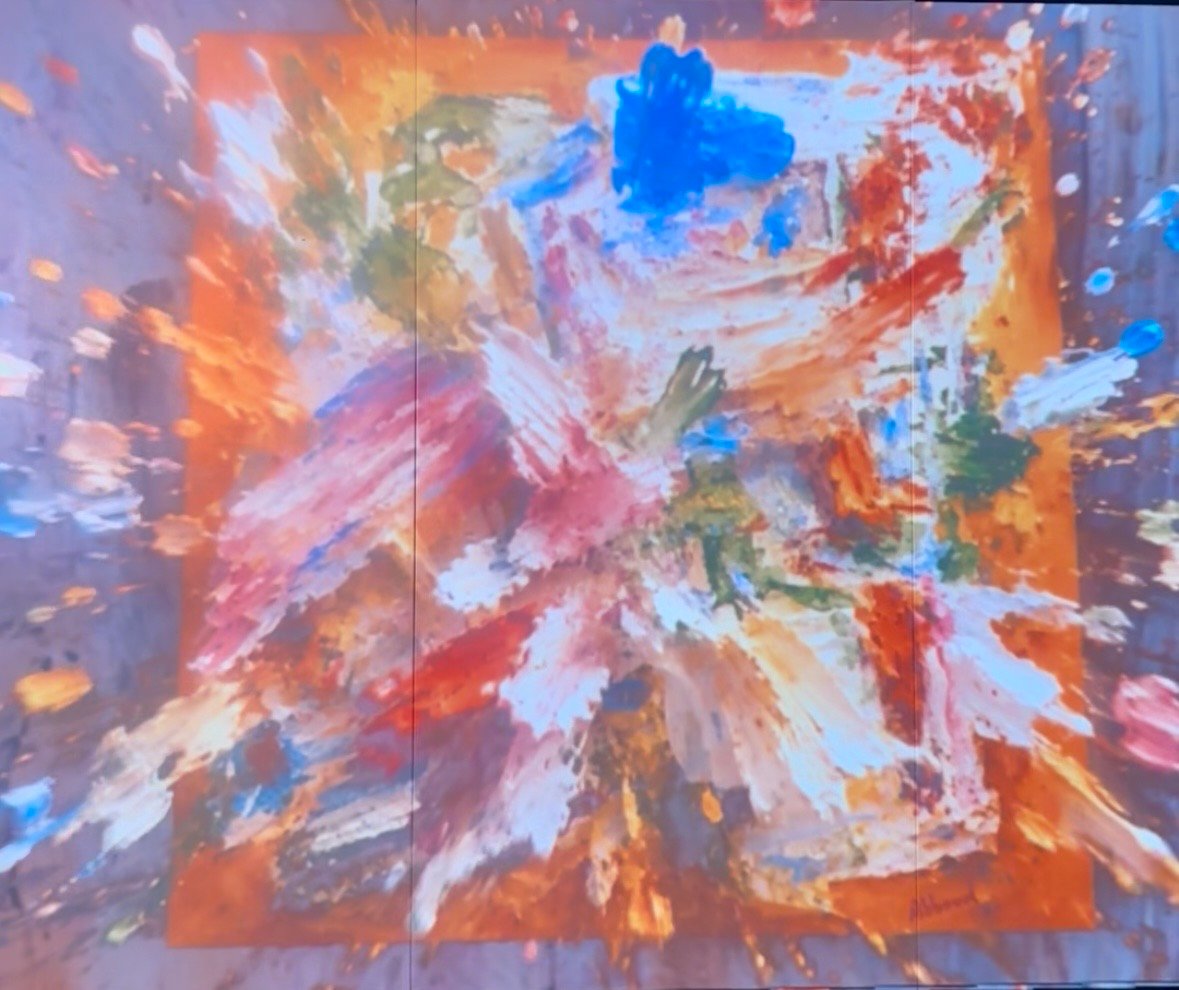
For La Nuit des Musées, the USEK Museum offered visitors the rare opportunity to rediscover that invisible life through Art in Motion, an immersive exhibition conceived by Elsie Deek Abou Jaoude, museum director, curator and art historian. Rather than using technology as a spectacle, the exhibition transformed it into a tool for seeing differently. Monumental projections, carefully animated from high-resolution images of the original paintings, invited visitors to step inside works that have shaped the history of Lebanese abstraction.

Four Masters, Four Artistic Universes
The strength of the exhibition lies first in the remarkable selection of artists.
The lyrical freedom of Chafic Abboud unfolded with extraordinary fluidity. His luminous compositions, already filled with an inner musicality, seemed to breathe as colors slowly traveled across the walls, revealing the subtle relationships between transparency, light and memory.
The powerful paintings of Jean Khalifé acquired another dimension. His vigorous impastos, generous chromatic contrasts and expressive gestures became almost sculptural once enlarged. The projection allowed visitors to follow the very direction of the brush, making visible the physical energy that remains embedded within the paint.
The poetic abstraction of Halim Jurdak, rooted in a profound dialogue between color and spirituality, revealed delicate rhythms that often escape a conventional museum visit. Enlarged beyond the frame, his compositions invited viewers into a contemplative experience where every nuance seemed suspended between silence and emotion.
The refined sensitivity of Vera Yeramian completed this remarkable journey. Her chromatic harmonies and subtle structures unfolded with quiet elegance, demonstrating how abstraction can speak through restraint as much as through composition.
Together, these four artists reminded visitors that Lebanese abstraction never followed a single path. Each developed a deeply personal language while contributing to one of the richest chapters of modern Lebanese art.

Looking Beyond the Painting
One of the greatest achievements of Art in Motion is that it never competes with the artworks. On the contrary, it leads us back to them.
After witnessing a brushstroke expand across an entire wall, one instinctively returns to the original canvas to discover details that had previously gone unnoticed. The immersive experience becomes an education of the eye. It teaches visitors to look longer, more slowly and more attentively.
In an era where technology often risks overwhelming art, this exhibition demonstrates that digital innovation can instead deepen our understanding of painting.

The People Behind the Experience
Every immersive exhibition is ultimately built by human hands long before it reaches the public. Behind the projections, the animations and the music stood an entire team whose creativity transformed an ambitious idea into a living experience.
The animations and visual projections were conceived and produced by the students and instructors of the School of Architecture and Design (Digital Media) under the direction of Reine Abbas, conforming to the vision of Elsie Deek Abou Joude, while the original musical compositions were created by the School of Music, giving each artwork its own rhythm and atmosphere. This was not simply a museum exhibition enhanced by technology. It was a genuine collaboration between the USEK Museum, the Digital Media program, and the School of Music, where art history, digital creation and sound met in the service of Lebanon’s artistic heritage.
Too often, visitors admire the final result without realizing how many minds and talents have contributed to it. These students and instructors deserve to be recognized alongside the curatorial team. Their work demonstrates that a museum can also be a place of transmission, where new generations do more than study art. They actively participate in bringing it to life.
The Vision Behind the Project
Such a project demanded not only technical expertise but also a deep understanding of art history. Elsie Deek Abou Jaoude deserves particular recognition for imagining and bringing to life an exhibition that successfully bridges heritage, education, technology and contemporary museum practice.
What makes this achievement even more remarkable is that it was realized with limited financial resources. The quality of the result invites an obvious reflection. With broader institutional support and greater cultural investment, this immersive experience could undoubtedly grow into one of the region’s most significant museum projects, capable of attracting an even wider audience and offering an even more ambitious visual journey through Lebanese modern art.
The realization of this exhibition was also made possible thanks to the commitment of generous sponsors whose support demonstrates the importance of private patronage in cultural life. Neovitale, Hanna Jewelry – The Daughters, and Univest all contributed to bringing this innovative project to the public, proving once again that partnerships between museums and committed private institutions can open new perspectives for the preservation and promotion of Lebanon’s artistic heritage.

A New Way of Seeing
The greatest success of Art in Motion is perhaps not that the paintings appeared to move.
It is that, once the projections faded and visitors stood once again before the original works of Chafic Abboud, Jean Khalifé, Halim Jurdak and Vera Yeramian, those paintings no longer seemed quite the same.
The exhibition had accomplished something far more enduring than spectacle. It had taught us to look again.