
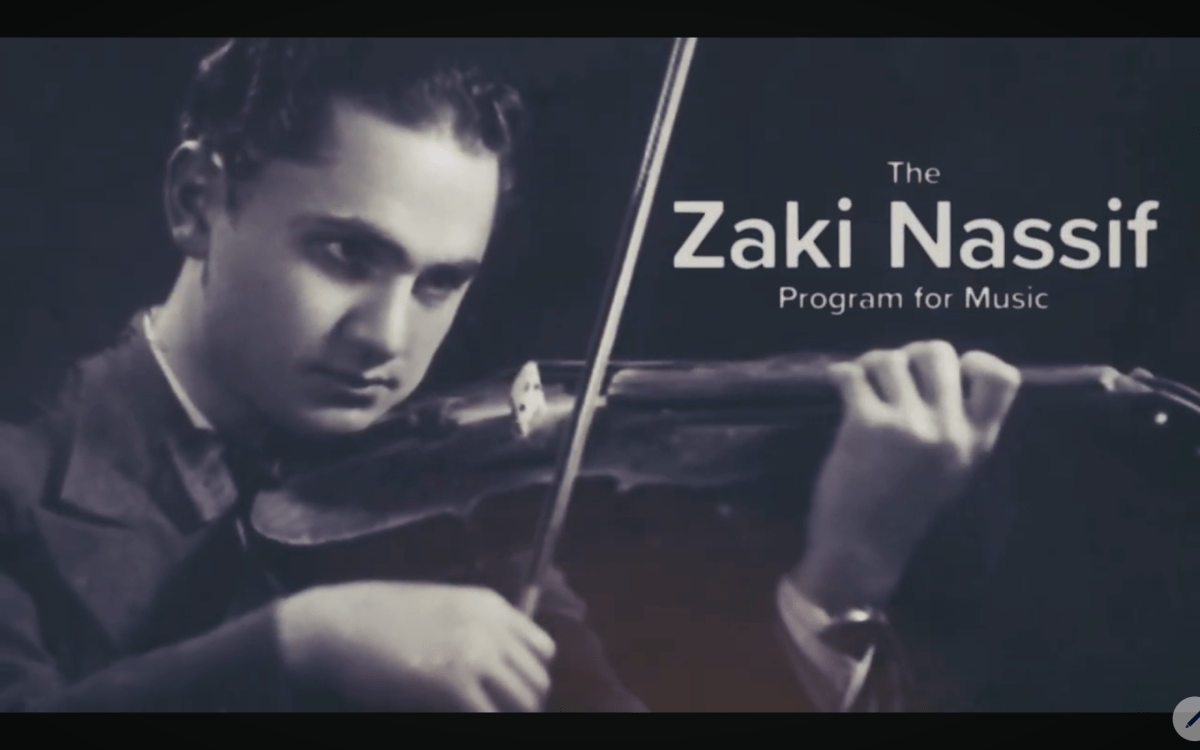
The Lebanese composer Nassif transformed the popular heritage from an oral memory in danger of being forgotten into a solid national musical identity, through a career that spanned 51 years in which he produced more than 1,100 pieces of music that embody the Lebanese person’s relationship with his land, nature, and history.
Zaki Shaker Nassif was born on July 3, 1916 in the town of Mashghara in the Bekaa, in a family of six children, of whom he was the youngest, amidst an atmosphere of famine and the scourges of World War I under Ottoman rule.
The episode (3/31/2026) of the “Ala Al-Nawta” program, which can be followed from this link, explains that the seed of his musical talent stemmed from his mother, who used to sing the sad melodies of “Al-Shoroukiyat,” and from the records of Sheikh Salama Hijazi and Sheikh Sayed Darwish that his father brought from the Levant.
The features of his musical personality were formed early. He learned to play the oud and the violin himself before any formal training, then in 1936 he joined the Music Institute at the American University of Beirut, where he studied under Russian teachers and mastered the piano and cello, which qualified him to understand musical arrangement with theoretical depth that was not common among popular composers at that time.
Nassif drew attention to the close connection between folklore and the land when he moved with his family between Mashghara and Beirut seasonally. The threshing floors, the reapers, and the threshing floors under the moonlight were seeping into his conscience and later turning into melodies.
When he met in 1953 with the Palestinian director Sabri Al-Sharif on Near East Radio, he found in the project to collect Levantine folklore his opportunity to ask a fundamental question: Why is inherited music not the primary material for musical composition in Lebanon?
The answer was embodied in 1955 when the “Gang of Five” was founded, which included Zaki Nassif, Assi, Mansour Rahbani, Tawfiq Al-Basha, and Tawfiq Sukkar, and announced the launch of a new phase for the Lebanese song.
The Baalbek Festival in 1957 allowed him to transfer a busy scene to the stage through the “Village Wedding,” where he created the dabke “Ya La La Aini,” inspired by its square rhythm from the movement of pressing grapes to make molasses.
Regarding his intellectual contribution to the development of the Dabkeh, Nassif explained that “Dalouna” is not just an emotional expression, but is from the Syriac root “Dil Aouna,” meaning “Come to the Help,” so he developed it into a six-step Dabkeh.
He also drew from Syriac and Byzantine melodies, the intonation of the Qur’an, and the origins of the letters, preserving the inherent musical identity while renewing it from the inside, not the outside.
He worked to employ Western music to serve the Eastern spirit. Nassif avoided using the piano whenever he found a “quarter voice” in the melody, in order to preserve the purity of the maqam from any distortion. This delicate balance between authenticity and modernity is what gave him the title of “Father of Folklore,” which he well deserved.
Nassif also worked with major Lebanese voices from Sabah, Wadih Al-Safi and Samira Tawfiq, and he created a nine-song CD for Fairouz that bore his name. The song “Return to Colonize Lebanon,” which he wrote and composed under bombardment during the days of war, was closest to his heart, as it brought tears to his heart whenever he heard it, because it was at its core a message of stubbornness and faith despite the devastation.
Zaki Nassif passed away on March 11, 2004, at the age of 88, leaving a huge archive that the American University of Beirut is responsible for preserving and publishing. Then his house in Mashghara was transformed into a museum and cultural center that receives those who want to return, as he once wrote: “I return to you, my village… to sleep in your peaceful shades… the dust of our ancestors.”
Source: Al Jazeera
Zaki Nassif Program at the American University of Beirut – Image source