
[“The following copyrighted article is shared
with permission, and courtesy of theartpulse.com”]
Source link
An Article by DM (812 words, 4 min. read)
When the Wires Become the City
There are details that quietly reshape a city until they become inseparable from its identity. In Beirut, electrical cables have gradually become one of those defining features. Suspended above streets, stretched between buildings and endlessly multiplied by years of improvisation, they have formed a second architecture floating over the first. In Off the Gridpresented at Art on 56th until July 25, Dyala Khodary turns this overlooked reality into the heart of her artistic practice. What was once considered temporary infrastructure becomes a visual language through which the city can be read.
Painting a City That Has Learned to Adapt
The exhibition takes its starting point from Lebanon’s electricity crisis and the widespread dependence on private generators. Yet Khodary moves far beyond documentary observation. Rather than illustrating a social issue, she explores the way prolonged instability slowly transforms the appearance of a place and, eventually, the way people perceive it.
The dense web of cables no longer functions simply as an object. It becomes a drawing spread across the sky, a silent map of adaptation and resilience. Beirut emerges as a city continually rewritten by necessity, where each new connection leaves another mark upon its landscape.

The Material Speaks
Material plays an essential role in this body of work. Khodary moves freely between jute, canvas, recycled paper and traditional supports, allowing each surface to contribute its own texture and character. The coarse fibers of jute, the fragility of recycled paper and the absorbent quality of the canvas all enrich the visual experience while reinforcing the exhibition’s dialogue with everyday urban reality.
Her technique follows a carefully constructed process. Layers of different paints are gradually applied until the city begins to dissolve. Buildings lose their sharp contours, streets become atmospheric impressions and landscapes seem suspended somewhere between memory and vision. The image is intentionally blurred, inviting viewers to search for what remains.
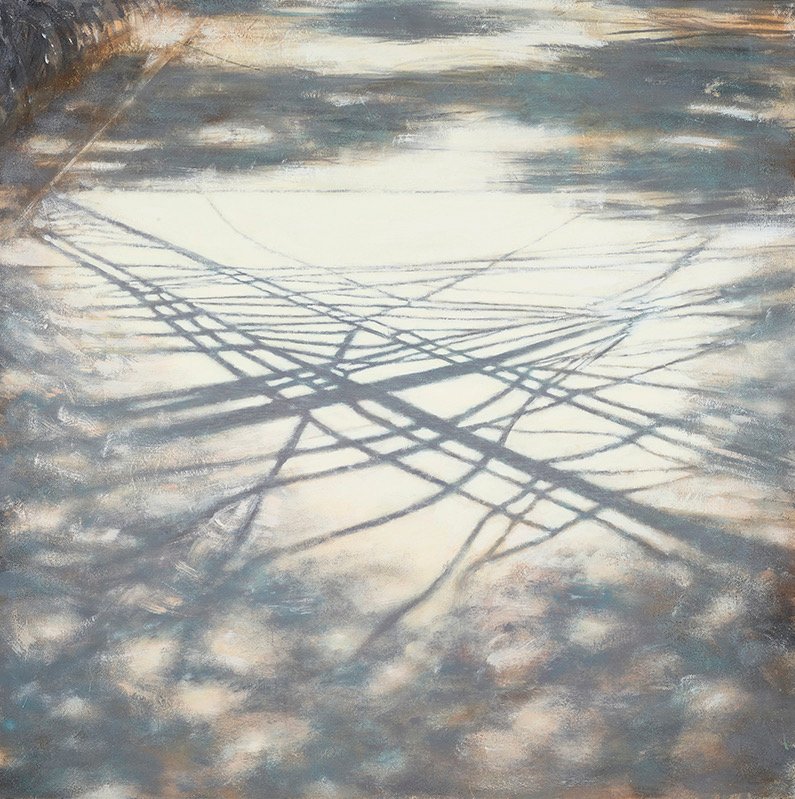
Only then do the wires appear. Drawn with energetic black lines, scratched into the surface or reinforced with real cables, they slice through the softened compositions with remarkable force. They become the most solid element of the landscape, almost more permanent than the architecture itself.

Looking Through the Network
Many of the works invite the viewer to look beyond the cables. Fragments of sea, reflections of clouds, distant buildings and quiet streets remain partially hidden beneath overlapping lines. The eye instinctively tries to reconstruct what lies behind them.
This experience closely mirrors daily life in Beirut. Residents have become so accustomed to this visual congestion that it often disappears from conscious perception. Khodary reverses this habit. She places the cables at the center of every composition so that they can no longer be ignored.
Several paintings are particularly striking in this regard. Reflections in pools of rainwater offer fleeting images of the sky, interrupted by dark lines that continue across their mirrored surfaces. Even moments of calm remain inseparable from the infrastructure that surrounds them.

From Painting to Installation
The exhibition expands beyond the traditional canvas through a large folded installation depicting a congested urban road beneath an orange evening sky. Thick electrical cables extend across the painted surface before continuing into real space, dissolving the boundary between artwork and environment.
The viewer no longer stands before the city but enters it. The installation recreates the sensation of moving through Beirut, where cables constantly frame one’s vision and accompany every journey. Painting becomes architecture, while architecture itself becomes part of the artwork.

The Beauty of the Ordinary
One of the strengths of Off the Grid lies in its ability to transform an ordinary urban nuisance into a compelling visual subject. Khodary does not romanticize the electrical crisis, nor does she rely on dramatic imagery. Instead, she asks viewers to observe what has become invisible through habit.
Her compositions reveal unexpected beauty within disorder. The crossing wires generate their own rhythm, almost spontaneous resembling calligraphic drawings suspended above the city. They create movement, balance and tension while quietly reminding us that beauty sometimes emerges from the very signs of fragility.

A Portrait of Contemporary Beirut
Beyond its formal qualities, Off the Grid It becomes a portrait of contemporary Beirut. It speaks of improvisation, endurance and the remarkable capacity of a city to reinvent itself under difficult circumstances. The electrical network is no longer merely a technical solution. It has become part of the collective memory and visual identity of the capital.
Diala Khodary succeeds in transforming infrastructure into metaphor without sacrificing the pleasure of painting. Through layered surfaces, blurred landscapes, recycled materials and bold linear interventions, she invites us to rediscover a city we believed we already knew. Her works remind us that every city writes its own history upon its walls, its streets and even its skies. In Beirut, that story has been drawn, quite literally, in wires.
