[“The following copyrighted article is shared
with permission, and courtesy of theartpulse.com”]
Source link
An Article by DM. (856 words, 5 min. read)
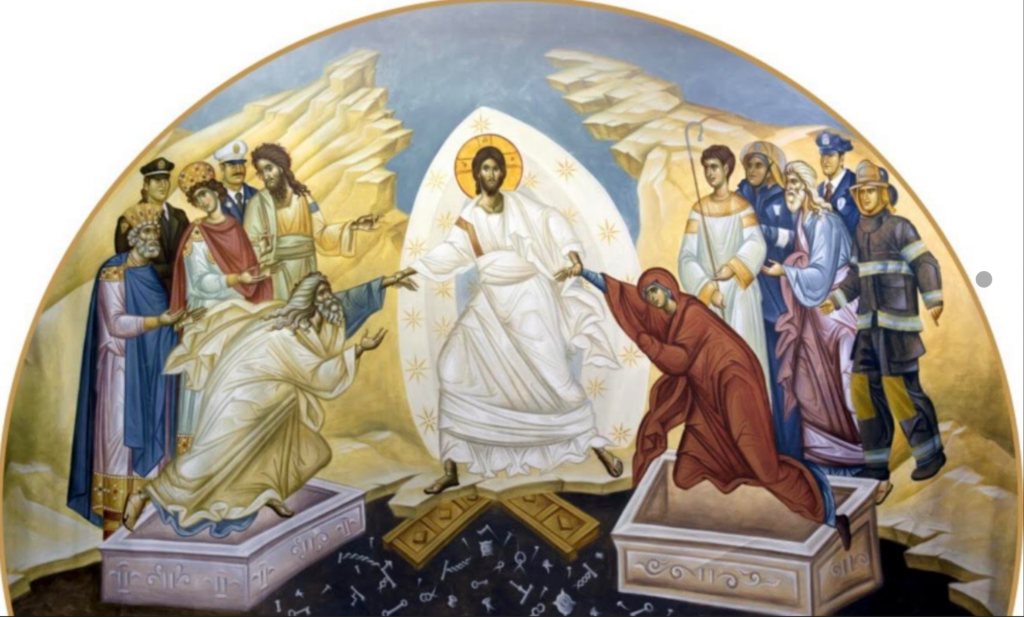
The image of resurrection enters the history of art through the language of early Christian and Byzantine representation, where the figure of Christ is placed within a symbolic order that defines both space and meaning. In these images, the body is frontal, hieratic, and suspended within a field that does not describe physical reality but conveys presence. The Anastasis, or descent into the underworld, presents Christ lifting Adam and Eve in a gesture that unfolds within a flattened, luminous space, structured through gold and line.

With the transition toward the early Renaissance, painters such as Giotto begin to introduce weight and volume into the body, situating the resurrection within an architectural and terrestrial environment.
This evolution reaches a point of balance in the work of Piero della Francesca, where the risen Christ stands in still authority above the tomb, dividing the composition between sleep and awakening, earth and elevation. The body becomes the axis of the image, holding together a world organized through proportion, geometry, and measured light.

Light, Flesh, and the Intensification of Presence
The seventeenth century brings a shift toward movement and intensity, where the moment of resurrection expands through the language of light and composition. In the work of Caravaggio, illumination becomes directional, cutting through darkness and revealing the body as a tangible presence shaped by shadow. Flesh carries weight, and the scene acquires a sense of immediacy that draws the viewer into its space. Painters such as Rubens expand this moment into a dynamic composition filled with upward motion, where drapery, limbs, and clouds participate in the ascent.

Modernity, Fragmentation, Matter, and Inner Resurrection
With the arrival of modernity, resurrection shifts from a defined theological scene into a broader exploration of the human condition. The body no longer occupies a stable structure but becomes subject to fragmentation, deformation, and reconstruction. In the work of Francis Bacon, the figure appears caught within forces that reshape it continuously, the surface carrying traces of tension and transformation.

In the material landscapes of Anselm Kiefer, the idea of rebirth is embedded in the very substance of the work, where ash, lead, and layered surfaces suggest cycles of emergence. The image of resurrection extends into an inner space, where the act of painting itself becomes a process through which the body and the world are
reconfigured.
Lebanon: Resurrection as Material Presence
Within Lebanese art, the theme of resurrection takes form through a direct engagement with material and surface. In the work of Mounir Najem, the face of Christ is constructed through a dense accumulation of pigment, where color is applied in angular fragments that shape the features with a sculptural intensity. The crown and the contours of the face appear interwoven with the surrounding space, creating a continuity between the figure and the ground. The presence of the figure emerges through layers that suggest time, pressure, and persistence, giving the impression of a body that takes form through the very act of painting.

The Vertical Figure and the Field of Light
In the work of Cici Sursock, the figure of resurrection unfolds along an elongated vertical axis that structures the entire composition. The body rises through a field of gold, its proportions extended and its presence anchored in a surface that carries visible traces of layering and inscription. The raised arms guide the movement upward, while the surrounding space absorbs and reflects light in a continuous manner. The figure appears integrated within the material, as if emerging from it while remaining part of its texture. The image holds together a sense of physicality and expansion, where the body becomes a conduit for a sustained upward movement.

Atmosphere, Dissolution, and Continuity
In the painting of Ibrahim Jabbour, the figure of resurrection is approached through an atmospheric treatment that softens contours and diffuses the body within a field of light. The surface is composed of gradual tonal transitions that allow the image to unfold gently across the canvas. The figure appears suspended, its presence defined through subtle variations rather than fixed outlines. This approach creates a sense of continuity between the body and its surrounding space, where the act of rising is
Expressed through a gradual expansion into light. The image holds a quiet intensity, where material and luminosity remain in balance.

The Persistence of the Verticality
From the early structured images of Byzantine and Renaissance painting to the dynamic intensities of the Baroque and the material explorations of modern art, the theme of resurrection continues to unfold through the figure as a vertical presence within the pictorial space. In Lebanese painting, this gesture finds a renewed articulation through surface, texture, and atmosphere, where the body is constructed, extended, or diffused according to the language of each artist. The image becomes a location where matter and light converge, allowing the figure to persist within a field that carries both memory and transformation.