[“The following copyrighted article is shared
with permission, and courtesy of theartpulse.com”]
Source link
An Article by DM (1008 words, 5 min. read)
On the evening of January 8, Mark Hachem Gallery opened its space for an occasion that exceeded a public unveiling, evolving into a moment of collective recognition where memory, art, and presence converged. A commendable leap forward in the millieu of art exhibitions.
The space filled early and steadily, drawing an unusually large and diverse audience that reflected the breadth of Jean Khalife’s reach across generations, disciplines, and geographies. Artists, writers, critics, collectors, students, and longtime admirers moved through the works with an attentiveness shaped by awareness that this gathering marked something that lasts. Conversations formed organically around surfaces, colors, and titles, yet beneath them ran a shared understanding that this was a rare to encounter a complete vision brought forward with meticulous care and refined intention.

A Project Anchored in Commitment
The direction of Dr. Tony Karamwhose engagement with modern and contemporary art in Lebanon, gave the project both scholarly depth and emotional clarity. His support extended beyond selection or organization; it shaped the narrative arc through which the works were encountered. The project honored continuity rather than chronology, allowing early figurative studies, mature abstract compositions, works on paper, engraved surfaces, and sculptural elements to coexist as parts of a single inquiry. A salvation of unique and never seen works added to the depth and magnitude of what was offered for everyone to see, admire and feel.
The result articulated a lifelong research grounded in discipline, reflection, and the refusal of easy classification.

The Language of Color and Form
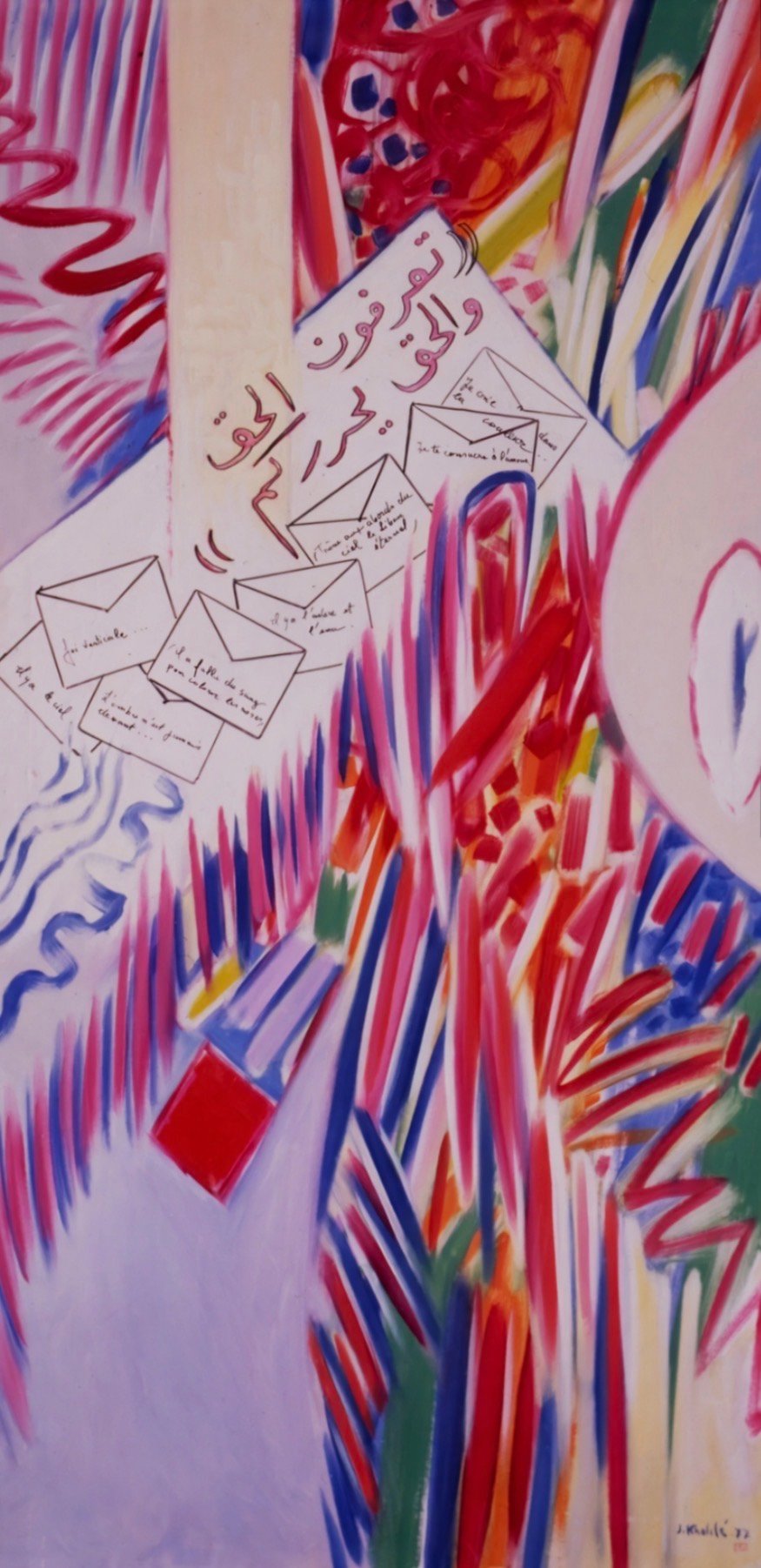
Moving through the works revealed a sustained dialogue between color and structure. Oil on masonite, canvas, cardboard, and paper carried fields of saturated reds, blues, greens, yellows, and violets arranged in bands, clusters, and rhythmic passages. Some compositions tightened into near-architectural balance, while others expanded outward through gesture and repetition.
From a distance, images resolved into cohesive constructions; up close, brushwork, revisions, and layered decisions became visible. Khalif’s own words echoed throughout the experience: “It’s color that guides the creation of my paintings… Seen from a distance, it tightens as a construction; seen closely, color is all its substance.”

From the Figure to Abstraction
Early drawings and studies anchored the exhibition in Khalifa’s rigorous training and observational precision. Charcoal and watercolor nudes revealed a confident understanding of anatomy, weight, and proportion, expressed through minimal means. Portraits executed with felt pen compressed identity into decisive contours, often privileging structure over likeness. These figurative foundations clarify the logic behind his later abstraction, where form dissolved without abandoning order.
As Khalifa once stated, “Painting a pot of flowers, a Lebanese farmer, a traditional landscape, is no longer an act of creation.” This position explained his move away from realistic subjects toward a visual language where meaning emerged through internal relationships rather than representation.

Material as Thought
The variety of supports and techniques reinforced the sense of constant inquiry. Masonite offered resistance and density; paper allowed immediacy and speed; engraved metal introduced line through incision rather than gesture; Relief and assembly expanded the surface into physical depth. Each medium became a site for testing limits rather than repeating solutions. Even sculptural works remained aligned with the same principles governing the paintings, treating volume as another form of structure and balance.
Khalife’s belief that a work constituted its own universe resonated clearly: “A painting is a partial and incomplete picture, yet it represents and constitutes a universe.”
Voices in Dialogue
As the evening progressed, the gathering shifted into a spoken exchange that extended the visual experience into language. A public conversation brought together esteemed journalists, critics, and poets Dr. Maha SultanDr. Faysal Sultanand Henri Zoughaib, whose deep reflections and thoughtful insights approached Khalife’s work from historical, critical, and poetic perspectives.
Their talks moved interestingly between analysis and memory, addressing abstraction as a position, pedagogy as legacy, and research as an ethical stance. The exchange underscored the artist’s role in shaping not only objects but ways of thinking, teaching, and seeing.
More inside stories and revelations of immense value are promised through talks by artist and art collector Joseph Faloughi, artist Maroun Hakim and poet and art critic Dr. Samar Nahed Hakim, an added valuable dimension to an exhibition of historical proportion.

A Son Carrying a Name Forward
Among the most moving moments of the evening came through the presence of Jim Khalifwhose words carried both intimacy and responsibility. His emotion was visible and shared, not as sentimentality but as testimony.
Speaking of a father whose life revolved around work, research, and integrity, he brought personal memory into dialogue with public legacy. His presence bridged generations, reminding those gathered that this body of work emerged from lived commitment rather than abstraction alone. The audience listened with attentiveness shaped by respect, sensing the weight of transmission taking place in real time.

Witnessing a Collective Recognition
Being present that evening meant witnessing how art functions when it becomes a point of convergence. The large attendance reflected not spectacle but acknowledgment, as visitors moved slowly and engaged in sustained discussion. The atmosphere carried focus rather than noise, shaped by curiosity and gratitude.
The gathering affirmed Khalifa’s place within the development of abstraction in the region, not through declaration but through shared recognition. His assertion resonated quietly:“The outside world is only an accessory. I carry my paintings in the core of my being; they are nailed to my skin.” That sense of inner necessity permeated the space.

Witnessing a Collective Recognition
What emerged most clearly was the idea of legacy as an active presence rather than a closed chapter. The works spoke across decades with consistency of intent, demonstrating how discipline enables freedom and how research sustains relevance.
This exhibition created conditions for renewed engagement with an artist whose influence extended through teaching, example, and unwavering commitment to form.
Standing there, surrounded by people, words, and works, the legacy felt tangible and alive, carried forward through dialogue, attention, and the quiet certainty that Jean Khalife’s universe continues to expand through those who encounter it.