
[“The following copyrighted article is shared
with permission, and courtesy of theartpulse.com”]
Source link
An Article by DM (1045 words, 6 min. read)
Power, Persona, and the Private Act of Painting
Fame organizes space. It fills halls, frames faces, amplifies voices. Painting asks for something quieter. It requires a room without spectators, a surface that receives color without applause. When political leaders, musicians, and actors turn toward the canvas, they enter a field where titles and box office numbers hold no function. The studio measures neither popularity nor authority. It measures attention, rhythm of hand, relationship to form.
Within that space, each figure reveals a distinct visual language shaped by biography and temperament.
The Landscape as Interior Refuge
Winston Churchill

Winston Churchill painted throughout the years marked by political responsibility and war. His canvases depict gardens, coastlines, and sunlit architecture. Color remains warm. Composition privileges calm horizons and measured light.
These landscapes do not narrate historical turmoil. They focus on still water, textured walls, flowering trees. The act of painting reorganized perception around natural elements and balanced structures. In this environment, decision making gives way to observation. The brush follows light rather than strategy.

Portraiture After Office
George W. Bush

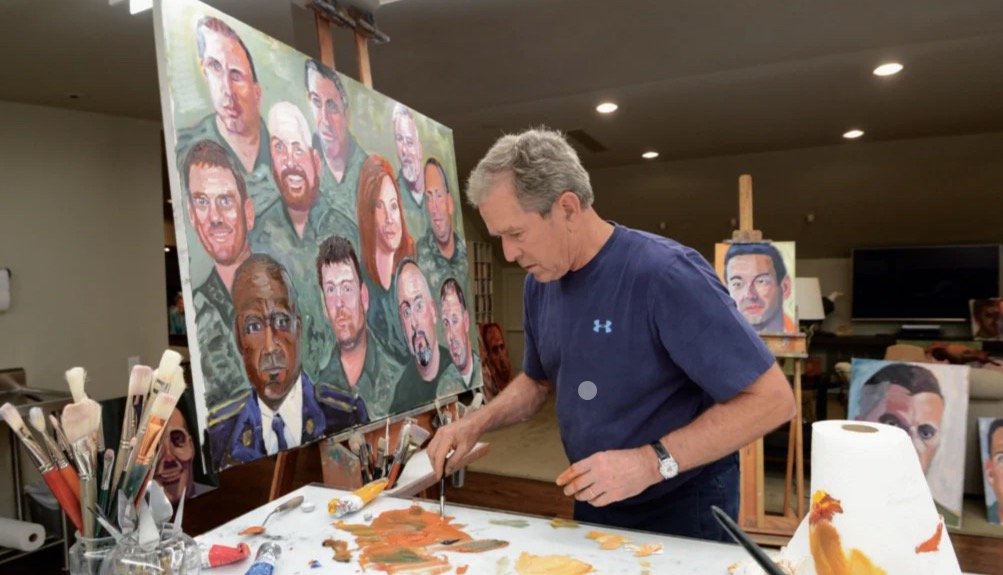
George W. Bush began painting after his presidency. His practice centers on portraiture. Veterans, immigrants, and personal acquaintances become subjects rendered in direct configuration. Facial structure and expression receive sustained attention.
Self portraits add intimacy. Domestic interiors replace public architecture. The focus on individual faces establishes a different scale of engagement. The studio becomes a site where the former head of state studies singular human features through line and color.


Abstraction and personal loss
Pierce Brosnan

Pierce Brosnan has maintained a painting practice across decades. After profound personal loss, abstraction assumed greater importance in his work. Expansive color fields and sweeping movements and structure of his canvases.
Pigment moves freely across the surface. Form dissolves into motion. The absence of defined figures allows emotion to inhabit color itself. The studio provides a framework where grief finds visual articulation through rhythm and density.


Movement as Reconstruction
Sharon Stone

Sharon Stone intensifies her painting practice following a severe stroke. Large canvases filled with vigorous strokes and saturated hues characterize her recent work.
The physical act of applying paint intersects with recovery. Coordination of hand and eye acquires renewed importance. Layer upon layer, the surface records motion and concentration. Painting participates in a process of reestablishing connection between body and intention.


The Visual Language of Song
Joni Mitchell

Joni Mitchell integrates painting into her musical identity. Self-portraits appear frequently, rendered with expressive contour and nuanced tonal shifts. Several album covers originate from her own hand.
The introspective quality of her songwriting finds visual correspondence in these images. The painted face becomes a field of examination. Line traces mood with the same attentiveness that melody grants to language.


David Bowie

David Bowie studied art before international recognition in music. His paintings often depict fragmented faces and distorted bodies. Expressionist shape influences strong color contrasts and dynamic composition.
Identity unfolds through layered features and altered proportions. The multiplicity that characterizes his work stage appears here in visual form. The canvas functions as another site of transformation.

Tony Bennett

Tony Bennett exhibited under his birth name, Anthony Benedetto. His landscapes of urban scenes and natural vistas reveal careful composition and harmonious color relationships.
The discipline associated with his vocal craft reappears in his visual work. Each painting demonstrates measured observation and steady technique. The studio becomes a parallel arena of artistic rigor.

Mika

Mika was formally trained in visual arts before his musical career. His illustrations and drawings feature vibrant characters, intricate motifs, and imaginative environments.
Album visuals and stage aesthetics originate in this graphic sensibility. Image and sound develop within the same conceptual architecture. Illustration expands the narrative world of his music through line and chromatic intensity.

Robbie Williams

Robbie Williams approaches painting through a combination of image and text. In exhibitions such as Pride and Self-Prejudicewritten statements about anxiety, addiction, and fame occupy the canvas alongside bold color and graphic shapes.
Words operate as compositional structures. Humor intersects with introspection. The surface resembles an enlarged page from a personal notebook, where confession becomes visual form. Painting provides a medium for direct articulation shaped by typography and p

Persona on Canvas
Johnny Depp

Johnny Depp creates portraits of cultural figures who influenced him. Strong outlines and vivid color blocks define many of these works. Musicians and actors become subjects rendered through stylized figuration.
The choice of iconic sitters establishes a dialogue between celebrity and artistic admiration. Portraiture becomes a study of artistic lineage.


Sylvester Stallone

Sylvester Stallone has painted since the nineteen seventies. His canvases frequently adopt a neo expressionist approach marked by vigorous brushwork and intense chromatic contrasts.
Certain works reference figures related to his film career. Motion dominates the surface, transforming physical energy into pictorial force.


Aesthetic Ambition Redirected
AdolfHitler

Adolf Hitler aspired to become a professional artist and sought admission to the Academy of Fine Arts in Vienna. His surviving works consist largely of architectural watercolors that demonstrate careful draftsmanship and controlled perspective. Buildings dominate the compositions. Human figures rarely appear.
The emphasis on structure, order, and monumental space anticipates a later fixation on rigid aesthetic criteria. A career devoted entirely to painting might have redirected that ambition into artistic production rather than political catastrophe. The canvases remain documents of an unrealized artistic path within a biography that took a devastating direction.


The Studio Without Titles
Across these varied practices, painting operates independently of political office, cinematic acclaim, or musical success. Landscapes, portraits, abstractions, illustrations, textual compositions, and architectural studies reveal different inner climates and technical approaches.
In many countries, local actors and media personalities also engage in painting. Some develop serious studio practices grounded in study and discipline. Others benefit from visibility attached to their public image. Recognition can open exhibition spaces, yet sustained artistic merit depends on rigorous engagement with form, material, and critical dialogue.
The canvas remains impartial. It responds to concentration, patience, and formal understanding. It does not respond to fame.
When leaders, musicians, and actors enter the studio, they confront materials that require humility. Pigment, surface, proportion, and composition demand commitment beyond applause. In that room, titles lose relevance. What remains is the trace of the hand and the measure of attention given to the art itself.