
[“The following copyrighted article is shared
with permission, and courtesy of theartpulse.com”]
Source link
An Article by MJ (508 words, 3 min. read)
When speaking about Henri Matisse, attention often goes to color, cut-outs, and painting. His most ambitious work takes another form. It is a space that can be entered and experienced over time.
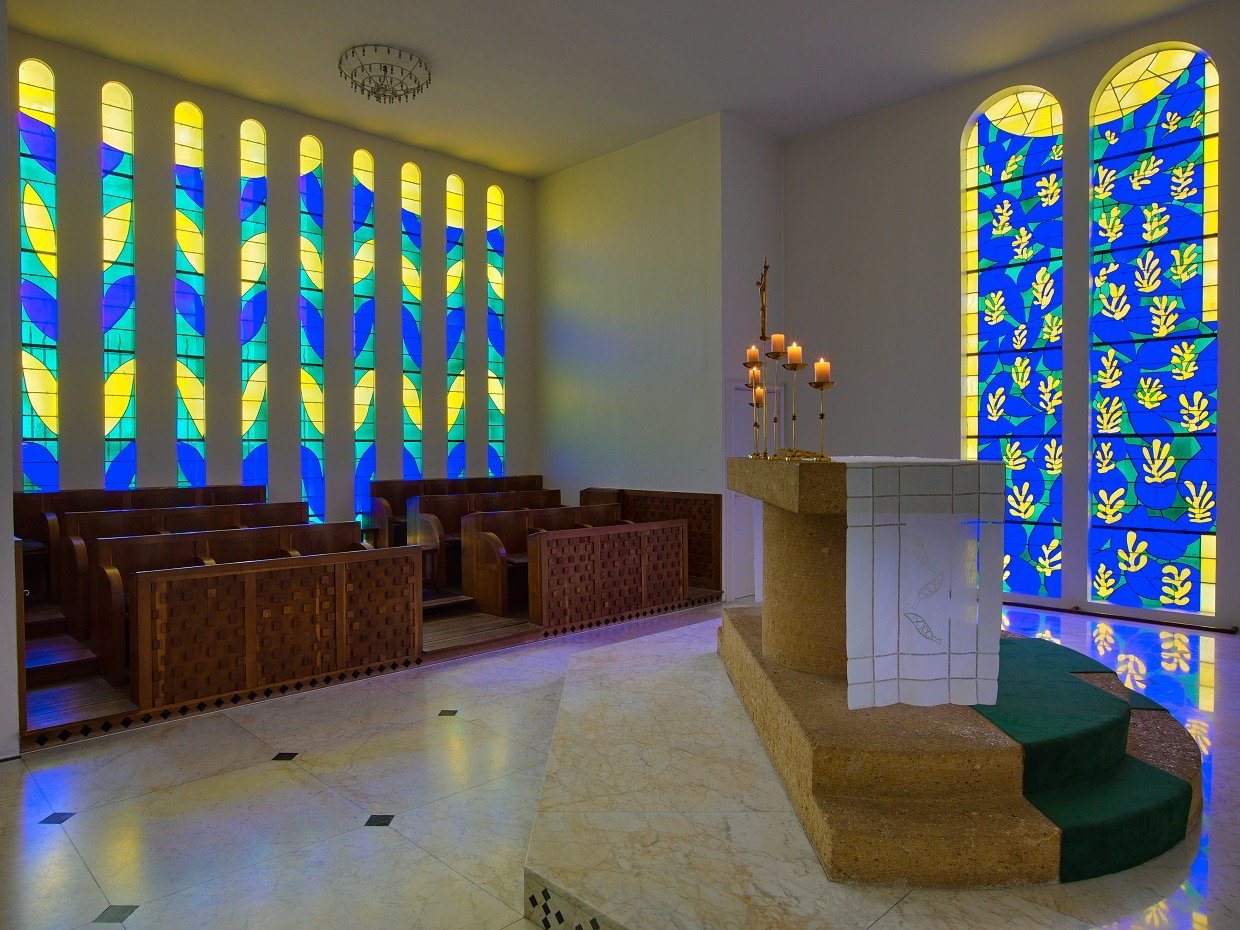
This work is the “Chapelle du Rosaire” in Vence (France), a masterpiece of sacred art designed and decorated by Henri Matisse between 1947 and 1951.
Matisse designed the entire place, including the architecture, the stained glass, the ceramics, and the objects used inside. The project brings together several disciplines into one environment.

A Meeting That Led to the Project
The chapel is closely linked to Monique Bourgeois. She first met Matisse as a nurse. Later, she became Sister Jacques-Marie after entering a religious order.
Their exchange played an important role in the development of the chapel. She contributed to the discussions and helped shape the project so it could function as a place of worship while keeping its artistic direction.

A Direct Visual Language
During this period, Matisse worked in a more simplified way. His physical condition led him to focus on clarity and essential forms.
The drawings inside the chapel use black lines on white ceramic surfaces. They depict religious figures and scenes with a reduced and controlled line.
Color appears through the stained glass. Blue, green, and yellow light enters the space and changes throughout the day. The atmosphere evolves with natural light.

A Project That Faced Opposition
The chapel did not receive unanimous support. Many voices questioned the idea of a modern artist designing a religious space. Some critics saw it as too simple, others as too distant from traditional church decoration.
Pablo Picasso reacted strongly to the project. He is known to have dismissed it with harsh words, expressing disbelief at the idea of Matisse dedicating himself to such a work. His reaction reflected a wider discomfort among artists who struggled to accept this direction.
These reactions reveal the tension around the project. The chapel introduced a different way of thinking about religious art, one based on reduction and clarity rather than ornament and detail.

A Space to Experience
The chapel invites movement. Visitors walk through the space and observe how light interacts with surfaces.
Walls, windows, and light are connected. The work surrounds the viewer and creates a continuous visual environment.
This approach places the viewer inside the artwork, allowing time and perception to become part of the experience.

A late work
The “Chapelle du Rosaire” belongs to the final period of Matisse’s life. It brings together his interest in line, color, and simplified form.
The project shows how his work expanded into architecture and space. It reflects a complete approach where different elements are brought into one place.

A Lasting Contribution
The chapel remains a significant example of an artist shaping a full environment. It continues to be experienced through light, space, and time.
It stands as a work that required conviction, especially in the face of doubt and criticism, and it remains central to understanding the final years of Matisse.