[“The following copyrighted article is shared
with permission, and courtesy of theartpulse.com”]
Source link
An Article by JA (908 words, 5 min. read)
Walking into the new presentation of Aref El Rayess at Sfeir-Semler Gallery, one experiences an unexpected emotion: happiness.
Not because the artist is unfamiliar, but because these works reveal a side of him that many viewers rarely associate with his name.
For decades, El Rayess has occupied a singular place in Lebanese art history as one of the artists who confronted violence most directly. His paintings, drawings, and political works looked directly at conflict.

Beyond Conflict
They carried the weight of wars, revolutions, injustice, and human suffering. Yet here, flowers bloom.
The exhibition brings together works that seem to belong to another emotional climate altogether. The title itself, J‘Aime les flowers as étoiletsalready suggests tenderness, wonder, and contemplation.
It invites the viewer into a universe where color becomes a form of joy and where painting appears to breathe differently.

A wider view
Yet flowers are only one part of the story. The exhibition spans several decades of El Rayess’s practice and reveals the remarkable breadth of his artistic language.


Moving through the gallery, visitors encounter works shaped by war, spirituality, architecture, literature, and personal reflection.
Rather than presenting a single narrative, the exhibition unfolds as a journey through the many worlds the artist inhabited.
Two Worlds, One Artist
What makes this exhibition particularly moving is the coexistence of seemingly opposite bodies of work.
On one side are the black-and-white drawings from 1978. Created during one of Lebanon’s darkest periods, they belong to the visual language many associate with El Rayess.
Their stark contrasts, nervous lines, and emotional intensity remind us that he was among the rare Lebanese artists who addressed war directly through vivid imagery and powerful forms.
Nearby, a group of gouaches on paper depicting fighters recalls the guerrilla warfare that erupted in the Lebanese mountains in 1958.

Executed with urgency and directness, these works capture the tension of a country in Turmoil.
They stand as early examples of El Rayess’s commitment to engaging with political realities.
On the other side emerge luminous pastel abstractions that seem to float beyond conflict.

Their colors vibrate with softness. Pinks, blues, yellows, and delicate greens move across the surface like petals carried by the wind.
The distance between these worlds appears immense, yet they belong to the same hand, painted a year later.
The exhibition reveals a complexity.
Waiting for a Daughter
Perhaps the most touching aspect of the exhibition is the story behind several of the oil pastel works. Titled: Hommage au Petit Prince, They were created while the artist’s wife was pregnant and the couple awaited the birth of their daughter Hala.

Knowing this changes the way one looks at the paintings. The colors appear filled with anticipation. Their softness resembles a state of emotional suspension, a period between uncertainty and hope. These works become traces of a father imagining a future life before it arrives.
There is something profoundly human in this shift. The same artist who observed war with such lucidity could also pause to contemplate flowers, stars, and the promise of a child.
Homages and Inspirations
The exhibition also highlights El Rayess’s fascination with cultural and intellectual heritage.
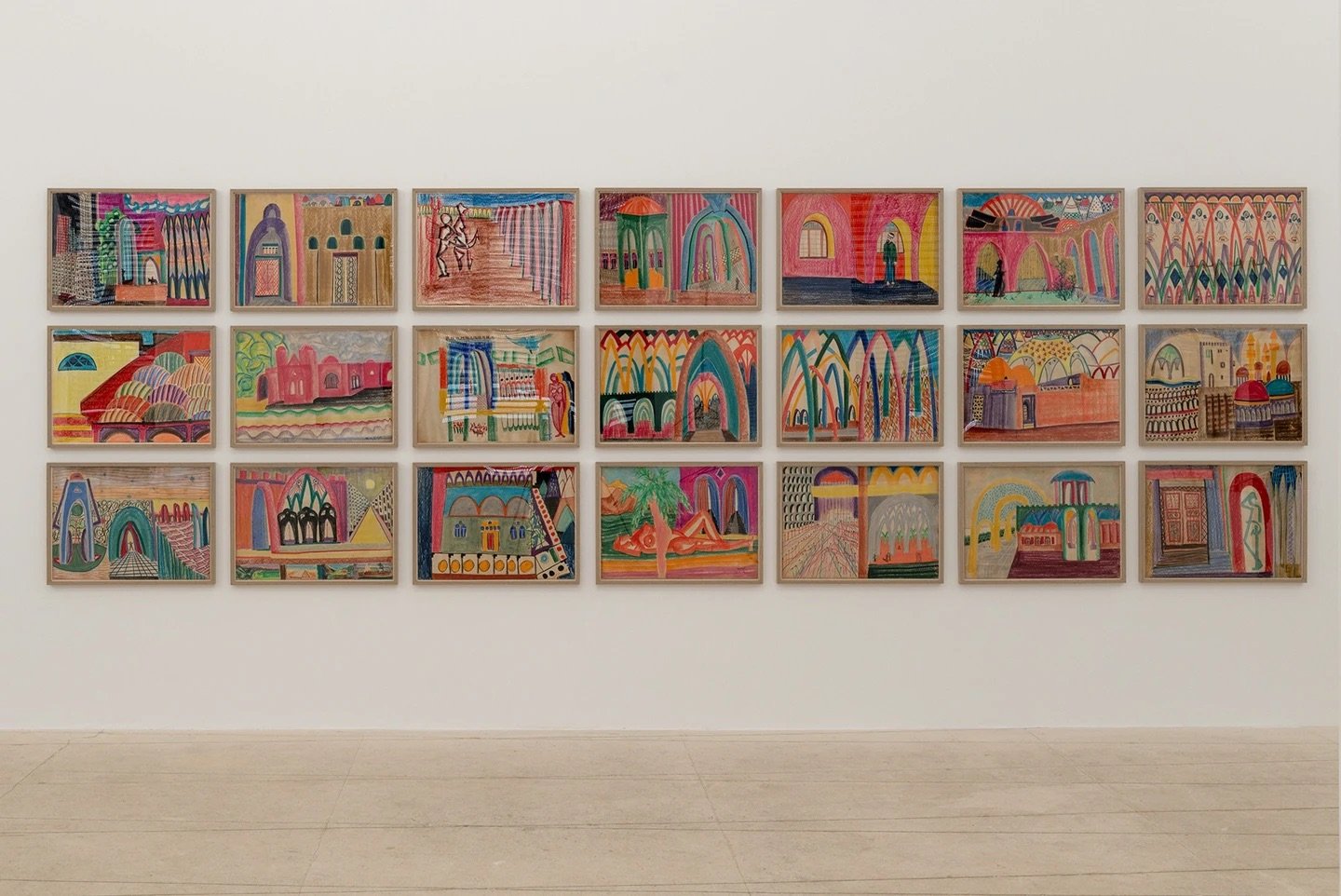
Among the most striking works is Tribute to Islamic Buildersa series that reflects his admiration for the creators of Islamic architecture.

Rather than depicting monuments directly, El Rayess evokes their spirit through rhythm, structure, and abstraction. The works reveal his engagement with the visual traditions of the region while remaining unmistakably modern.
A selection of pastel and gouache works from the 1960s and 1970s further demonstrates his restless experimentation. These pieces move freely between figuration and abstraction, revealing an artist constantly searching for new forms of expression.
Painting on velvet
The exhibition also includes a remarkable group of paintings on velvet. This unconventional support allowed El Rayess to explore texture and luminosity in new ways. The dark surface absorbs light while intensifying color, creating images that appear both theatrical and intimate.

These works demonstrate his willingness to experiment with materials throughout his career. They also reveal his desire to move beyond expectations, whether aesthetic or political.
Color Against Darkness
The exhibition reminds us that artists are never confined to a single subject. El Rayess is often remembered through the lens of his political engagement, his revolutionary spirit, or his depictions of violence.

These dimensions remain essential to understanding his legacy. Yet this presentation expands the picture. The flowers exist alongside the war drawings. The war drawings enrich the meaning of the flowers.
Each body of work illuminates the others. The darkness makes the colors brighter. The flowers make the violence more heartbreaking.

Together they reveal an artist capable of moving between despair and tenderness, protest and contemplation, history and intimacy.
Few artists possess such range. Fewer still can make these extremes feel equally authentic.
Painting Life Entirely
More than a presentation of artworks, this exhibition becomes a portrait of artistic freedom.
It reminds us that a painter’s responsibility is to record catastrophe and preserve beauty when beauty exists.

Aref El Rayess painted war because it demanded his attention. He painted flowers because they inspired him as well. He also painted fighters, builders, dreamers, and visions drawn from literature and memory.
Standing before these works today, one realizes that all these impulses belong to the same vision: a determination to paint life in its entirety, from its deepest wounds to its most fragile blossoms.