
[“The following copyrighted article is shared
with permission, and courtesy of theartpulse.com”]
Source link
An Article by MJ (666 words, 4 min. read)
Within the history of Lebanese painting, Amine Sfeir occupies a space shaped by discretion and continuity. Born in 1932, he belonged to a generation that witnessed the cultural and artistic transformation of Lebanon in the mid-twentieth century. His work focused on inner feeling and personal memory.
His paintings move slowly, based on what he saw and what he remembered. The gesture remains restrained, the compositions are intimate, the atmosphere contemplative. Across decades of practice, his work maintained a consistent sensibility centered on the preservation of feeling.

Painting as Recollection
Sfeir’s canvases present moments that seem to surface from within memory. A child seated in a classroom, a mother holding her infant, a village resting in stillness, these scenes emerge with a softened clarity.
The brushstroke plays a central role in this construction. Applied in small, vibrating touches, it shapes forms that appear gently diffused. Contours remain open, allowing figures and spaces to breathe within the surface of the painting.

The Intimate Subjects
Sfeir returned consistently to a group of themes rooted in human experience: childhood, motherhood, education, and village life. These subjects carry a quiet density, developed through composition, proximity, and presence.
The figure of the mother appears as a central motif, holding within it a sense of continuity and care. The classroom introduces a shared space where attention, formation, and stillness coexist. The village gathers these experiences into a broader environment shaped by familiarity.

Between Impression and Expression
Sfeir’s pictorial language develops within a subtle dialogue between impressionist sensitivity and expressive depth.
The surface is animated by broken brushstrokes that capture variations of light and tone. At the same time, the painting carries an inner light, where emotion spreads gently across the canvas. The image shows throughout a balance, where perception and feeling remain closely intertwined.
This approach produces a visual language marked by fluidity, where form and color remain in continuous relation.

The Palette of Restraint
Color in Sfeir’s work is guided by moderation and tonal harmony. His palette often includes soft browns, muted blues, and delicate ochres, arranged in subtle transitions.
These tonal relationships create a unified surface in which no single element dominates. Light appears diffused, moving through the composition with a quiet luminosity. The chromatic structure contributes to the sense of continuity.


The Village as an Inner Landscape
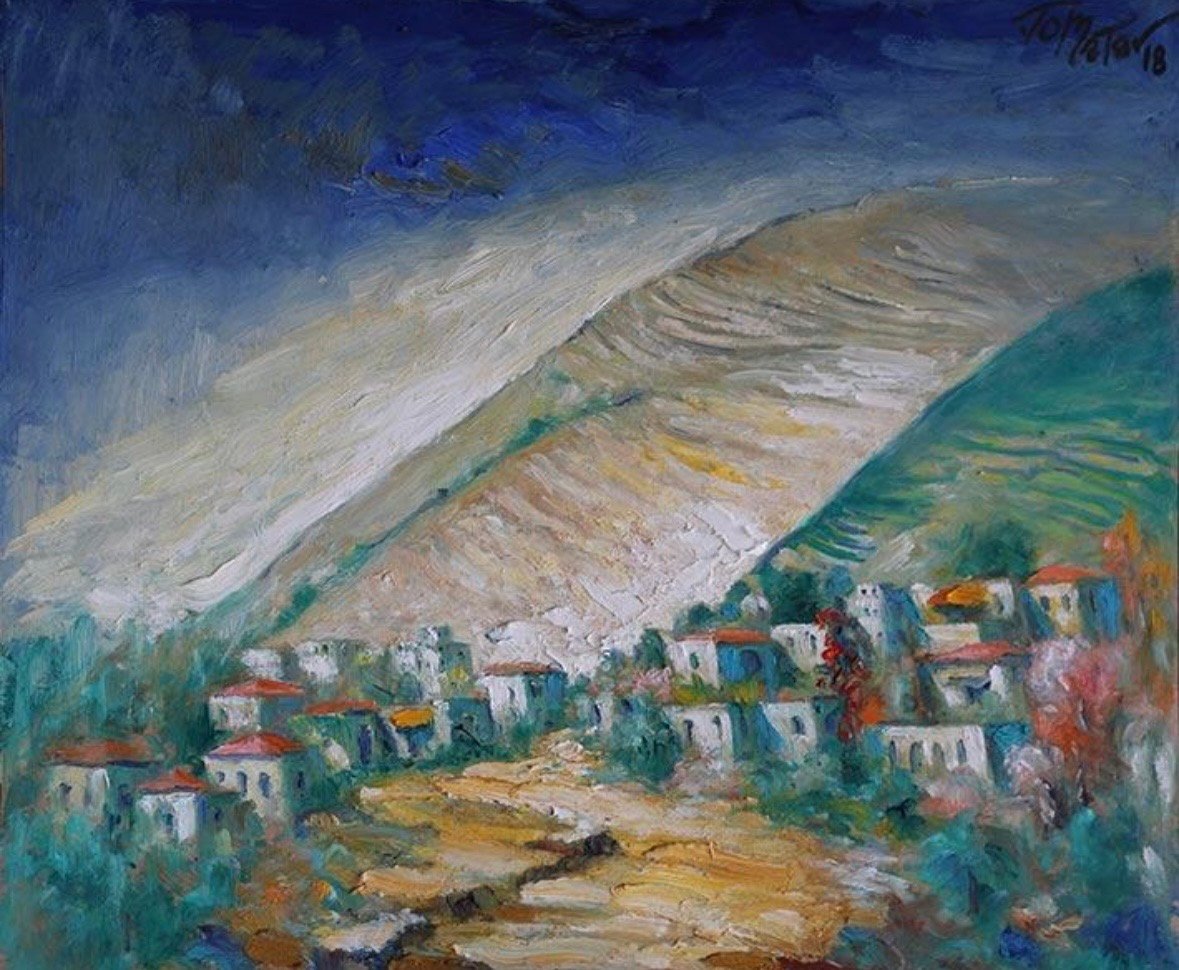
In paintings such as Bcharre, the village becomes a space shaped by memory. Architecture appears simplified, integrated into the surrounding environment. Houses, pathways, and forms gather into a cohesive field where spatial boundaries remain fluid.
This landscape carries a sense of familiarity, rooted in lived experience and recollection. The village functions as a place of return, where personal and collective memory intersect within the pictorial space.

Figures as Presence
The human figure in Sfeir’s work is rendered with a lightness. Faces remain softly defined and bodies are integrated into the surrounding atmosphere.
This treatment allows the figure to exist within the painting as part of a broader field of relations. The viewer encounters these figures through proximity and shared space, where emotional resonance circulates through posture and placement.


An Art of Continuity
Sfeir’s work reflects a sustained engagement with painting as a space of observation and reflection. His exhibitions in Lebanon, including those held during the 1970s, situate him within the wide artistic landscape of his time.
His practice developed through consistency, maintaining a clear focus on intimate subjects and measured expression. The continuity of his work contributes to a greater understanding of Lebanese painting as a field shaped by diverse approaches and sensibilities.

The persistence of memory
The paintings of Amine Sfeir are shaped by a quiet, enduring presence. Each composition carries a sense of time held within the surface, where forms, colors, and gestures remain in gentle suspension.
The observer enters a space where memory, perception, and emotion converge. The image remains open, allowing its atmosphere to extend beyond the frame, sustained by the subtle persistence of what has been lived and felt.

